

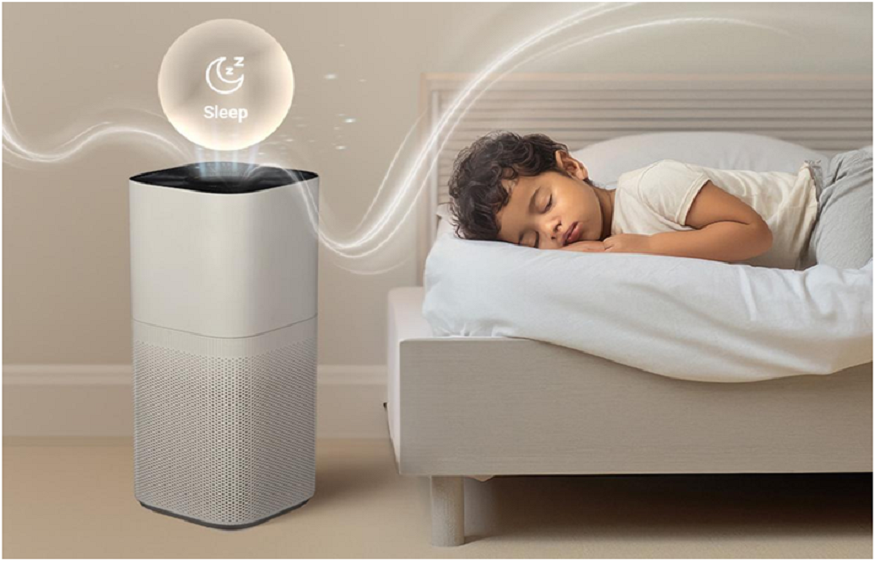
Indoor air quality often gets overlooked simply because most of what we breathe remains completely invisible. We certainly notice dust settling on a coffee table, but microscopic elements like pet dander, pollen, smoke, and volatile organic compounds (VOCs) float freely through our living spaces every single day. The process of air purification is quite linear and easy to understand. Let’s have a look!
What is Indoor Air Quality (IAQ)?
Airborne pollutants vary dramatically in size, which experts measure in units called microns. To help you understand better: a single strand of human hair is about 70 microns across. Nuisance particles of the larger variety, like visible dust, carpet fibers, and pet hair, are fairly easy to spot and clean up. The real challenge comes from microscopic hazards measuring under 2.5 microns, known as PM 2.5. These tiny invaders include tobacco smoke, bacteria, fine mold spores, and combustion byproducts. Our body’s natural defences are no match for these tiny particles, and therefore we require specialized equipment that is engineered specifically to clear them up.
Read More : Do Air Purifiers Actually Work? Or Is It Just Marketing?
How Do the Best Air Purifiers Work?
High-performance units layer specialized technologies together which target distinct airborne pollutants at every step:
Pre-Filter: This physical layer is the initial barrier that intercepts coarse dust, lint, and pet hair. Clearing away these heavy particles prevents premature clogging and shields internal components.
True HEPA H13 Filter: This is specially engineered for micro-pollutants. The True HEPA H13 filter traps up to 99.97% of ultra-fine particles as tiny as 0.1 microns. It effectively captures fine particulate matter, pollen, mold spores, and airborne allergens.
Activated Carbon Filter: Designed specifically for gaseous hazards, this layer uses the process of adsorption. Simply put, it binds chemical vapors, VOCs, smoke, and persistent household odors to its vast, highly porous surface structure.
The absolute benchmark for mechanical performance is True HEPA. HEPA stands for High-Efficiency Particulate Air. To be worthy of this label, a filter must capture at least 99.97% of airborne particles down to 0.3 microns, capturing even fine particulates like PM 2.5.
And do not forget to keep an eye on the Clean Air Delivery Rate, or CADR, which tells you how fast a purifier moves clean air through a specific room size.
Choosing the Best Air Filter for Home
Finding the best air filter for home comes down to matching the system to your specific household needs. Keep these key factors in mind before making a purchase:
- Room Size: Buy an air purifier that’s commensurate with the size of the room. A unit built for a small bedroom will fall short if it’s placed in a large living room or open kitchen.
- Filter Types: Choose a strong multi-stage air purifier. The best systems combine a pre-filter, a HEPA filter, and an activated carbon filter. Advanced models may also feature plasma filtration or ionizers.
- Noise Level: Be sure you check the decibel rating before buying an air purifier. You don’t want an air purifier that reduces air pollutants but increases noise pollution!
- Clean Air Delivery Rate (CADR): CADR measures how fast an air purifier filters smoke, dust, and pollen out of the air. Make sure you choose a unit with a CADR rating that’s appropriate for the square footage of your room. An air purifier with a low CADR will struggle in a larger space.
- Smart Features: Many air purifiers are now highly equipped with sophisticated features to help you maintain air quality. A WiFi-enabled purifier can help you control it remotely from any corner of your home. There are many devices with a digital display that help you monitor air quality in real-time.
Maintenance and Best Practices
Even the most advanced purifier loses its edge without basic upkeep and smart placement. Here is how to keep your purifier running at peak strength:
- Clean Pre-Filters Routinely: Outer pre-filters do the heavy lifting by trapping coarse debris, lint, and pet fur. A quick cleanup every few months keeps air flowing smoothly.
- Replace Primary Filters Based on Usage: Main HEPA and activated carbon layers gradually fill up over time. Keep an eye out for drops in airflow or unit indicator lights. That is your cue to swap them out.
- Position for Unobstructed Airflow: Where you place your purifier matters just as much as the technology inside it. Leave at least twelve inches of space on all sides. This prevents furniture or walls from choking the air intake.
Read More : Ensuring a Pest-Free Home: A Comprehensive Guide to Professional Residential Protection
Final Thoughts
Matching a multi-stage filter system to your specific space creates a reliable defense against airborne pollutants. Pairing that setup with consistent, timely maintenance keeps the air output pure and protects your investment.